
Financial Economics Books

|
Applied Computational Economics and Finance
by Mario J. Miranda and Paul L. Fackler This is an excellent book for self-study of applied computational methods. If you've been taught this theory but still feel stuck in approaching applications or having a deeper understanding of the solutions, this book will help you get unstuck. It is perfectly pitched to be of use to first-year graduate students as a supplement, and as a reference for practicing economists. It coveres solving systems of linear and nonlinear equations, functional approximation, and dynamic programming. The many examples of dynamic programming problems will solidify understanding. Between this book and Kenneth Judd's excellent Computational Methods in Economics, I'd say Miranda and Fackler's book is the gentler introduction to numerical methods, contains explicit example code to make concepts concrete, and employs a broader set of examples from economics and finance, whereas Judd covers macroeconomic modeling (his specialty) in more detail. Judd is thanked by Mirande and Fackler for offering feedback on their book, and I use the two books more as complements than substitutes. The sections on constrained optimization are somewhat idiosyncratic and underdeveloped. |

|
Market Models
- A Guide to Financial Data Analysis
by Carol Alexander Chapters: 1. Understanding volatility and correlation. 2. Implied volatility and correlation. 3. Moving average models. 4. GARCH models. 5. Forecasting Volatility and Correlation. 6. Principle component analysis. 7. Covariance matrices. 8. Risk measurement in factor models. 9. Value-at-risk. 10. Modelling non-normal returns. 11. Time series models. 12. Cointegration. 13. Forecasting high-frequency data. Technical appendices: A1. Linear Regression. A2. Statistical inference. A3. Residual analysis. A4. Data problems. A5. Prediction. A6. Maximum likelihood methods. |

|
Numerical Methods in Finance
- A MATLAB-Based Introduction
by Paolo Brandimarte |

|
Strategic Asset Allocation
by John Y. Campbell, Luis M. Viceira Oxford University Press |

|
The Econometrics of Financial Markets
by John Campbell, Andrew W. Lo, and A. Craig MacKinlay |

|
Asset Pricing
- Revised Edition
by John Cochrane Princeton University Press |

|
Introduction to the Economics and Mathematics of Financial Markets
by Jaksa Cvitanic and Fernando Zaperto MIT Press |

|
Solutions Manual
- Introduction to the Economics and Mathematics of Financial Markets
by Jaksa Cvitanic and Fernando Zaperto MIT Press |

|
An Introduction to High-Frequency Finance
by Michel M. Dacorogna, et al. |

|
Financial Crises
- And What to Do About Them
by Barry Eichengreen |

|
Modern Portfolio Theory and Investment Analysis
by Edwin J. Elton, Martin J. Gruber, Stephen J. Brown and William N. Goetzmann Wiley Now in its 9th edition, this book examines portfolio construction and investment analysis from a theoretical standpoint and is more suitable for the student or advanced practitioner rather than the typical individual investor. Three of the four authors are professors at New York University (and the fourth at Yale), where the book has been used for courses in portfolio theory including modern portfolio theory and general equilibrium models (capital asset pricing models and arbitrage pricing models). The new edition adds material on the causes of the financial crisis of 2008, factor-based investing, and current research and applications of Bayesian methods in finance. |

|
Non-Linear Time Series Models in Empirical Finance
by Philip Hans Franses and Dick van Dijk |

|
The New Finance
- The Case Against Efficient Markets
by Robert A. Haugen |

|
Value-at-Risk
- Theory and Practice
by Glen Holton |
|
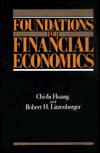
Foundations for Financial Economics
by Chi-fu Huang, Robert H. Litzenberger Prentice Hall |

|
Puzzles of Finance
- Six Practical Problems and Their Remarkable Solutions
by Mark Kritzman This small book is loaded with insights to make better financial decisions. Much of what passes as common sense investment rules of thumb contain logical falacies or violate certain principles of financial mathematics and risk management. This book sets it straight, being clear to show the assumptions under that make the arguments hold together. Chapters: 1. Siegel's paradox; 2. Likelihood of loss; 3. Time diversification; 4. Why the expected return is not to be expected; 5. Half the stocks all the time or all the stocks half the time; 6. The irrelevance of expected return for option valuation; Primer: 7. Financial concepts and quantitative methods. |

|
Computational Finance
- Numerical Methods for Pricing Financial Instruments
by George Levy |

|
Modern Investment Management
- An Equilibrium Approach
by Bob Litterman Wiley Finance Written by a creator of the Black-Litterman asset allocation model, this book introduces the investment management techniques used by Goldman Sacks asset management for its clients. With several chapters contributed by other members of Goldman Sachs Quantitative Resources Group, the book weighs in at more than 600 pages! The "equilibrium approach" the book advocates recognizes the world as a complex system subjected to a constant barrage of random shocks. Such shocks knock the system away from equilibrium and create potentially exploitable profit opportunities. |

|
A Non-Random Walk Down Wall Street
by Andrew Lo and Craig MacKinlay Chapters: 1. Introduction. 2. Stock market prices do not follow random walks: Evidence from a simple specification test. 3. The size and power of the variance ratio test in finite samples: A Monte Carlo investigation. 4. An econometric analysis of nonsynchronous trading. 5. When are contrarian profits due to stock market overreaction? 6. Long-term memory in stock market prices. 7. Multifactor models do not explain deviations from the CAPM. 8. Data-snooping biases in tests of financial asset pricing models. 9. Maximizing predictability in the stock and bond markets. 10. An ordered probit analysis of transaction stock prices. 11. Index-futures arbitrage and the behavior of stock index futures prices. 12. Order imbalances and stock price movements on October 19 and 20, 1987. |

|
Fractals and Scaling in Finance
by Benoit B. Mandelbrot |

|
The Misbehavior of Markets
by Benoit B. Mandelbrot, Richard L. Hudson |

|
Mean-Variance Analysis in Portfolio Choice and Capital Markets
by Harry M. Markowitz, G. Peter Todd, William F. Sharpe Wiley |

|
Efficient Asset Management
- A Practical Guide to Stock Portfolio Optimization and Asset Allocation
by Richard O. Michaud Oxford University Press |

|
Applied Computational Economics and Finance
by Mario Mirande and Paul L. Fackler MIT Press |

|
Market Volatility
by Robert Shiller |

|
Inefficient Markets
- An Introduction to Behavioral Finance
by Andre Shleifer |

|
Analysis of Financial Time Series
by Ruey S. Tsay |

|
Paul Wilmott on Quantitative Finance
- 2 Volume Set
by Paul Wilmott |