
Technical Analysis and Stock Trading System Books
Technial analysis aims to predict the direction and magnitude of future prices of stocks and other tradeable instruments. Trading systems aim to implement those predictions into explicit rules for when to buy, sell, or hold. The best books on technical analysis and how to design trading systems offer ideas for objective, quantitative, and specific trading rules. The best books also provide: evidence, evidence, evidence! Books focued on the subjective, ambiguous, visual reading of stock charts do not meet this standard. Here we highlight our top picks.

|
Technical Analysis from A to Z
by Stephen Achelis |

|
StreetSmart Guide to Timing the Stock Market
- When to Buy, Sell, and Sell Short
by Colin Alexander |

|
New Thinking in Technical Analysis
- Trading Models from the Masters
by Rick Bensignor |

|
Stock Market Strategies that Work
- Finding Winning Stocks, Using Technical Indicators Effectively, and Techniques…
by Jake Bernstein and Elloit Bernstein |

|
Bollinger on Bollinger Bands
by John Bollinger |

|
Technical Analysis for the Trading Professional
by Constance Brown |

|
It's When You Sell That Counts
by Donald L. Cassidy This book is long on the psychology of selling stocks and short on actual quantifiable rules to trade by. To many of the suggestions depend on the kind of foresight that, if you had it, would make books on trading irrelevant, e.g., "Sell some stocks when an extended market advance has exceeded realistic growth rates" and "Sell on an unsustainable upward price spike on big volume." So what is realistic and what is unsustainable? The one explicit set of quantitative selling rules involves what is termed the "personal diffusion index" which is the percent of stocks in a portfolio or universe that have increased over the past 3 months. Trading rules are developed on this index such as on a decline from 90 percent to 50 percent: "immediate final sell signal--this is the market top. Act without delay or excuses." Unfortunately, no statistical evidence is presented that using these rules will result in better trades than some alternative (which is not to say the index does not have predictive power). Selected chapter titles: Hidden reasons we resist selling, Require realism to support hope, Forget your cost price, Understand that you sell the stock, not the company; Be a contrarian; Focus on the time value of money; Rethink that old buy-and-hold religion; Separate selling from new buying; Use the Personal Diffusion Index; Overcome greed: Stop chasing the last eighth; Sell when it just feels so good; Use above-market instead of stop-loss orders; Sell smart on good news; Understand how bad the bad news is; The hold/sell decision checklist. |

|
The Encyclopedia Of Technical Market Indicators, Second Edition
by Robert Colby |

|
Connors on Advanced Trading Strategies
by Laurence Connors |

|
Street Smarts
- High Probability Short Term Trading Strategies
by Laurence A. Connors and Linda Raschke |

|
Professional Stock Trading
- System Design and Automation
by Mark R. Conway and Aaron N. Behle |
|
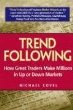
Trend Following
- How Great Traders Make Millions in Up or Down Markets
by Michael W. Covel |

|
Advanced Swing Trading
- Strategies to Predict, Identify, and Trade Future Market Swings
by John Crane |

|
Technical Analysis of Stock Trends
by Robert Edwards, John Magee, W.H.C. Bassetti |

|
Trading for a Living
by Alexander Elder |

|
Rocket Science for Traders
by John F. Elders Even for those with the requisite mathematical training, this book is very hard to follow. We implemented many of the procedures in this book but were unable to find a system that worked well for stocks. Nonetheless, it does present some interesting signal-processing techniques for identifying the amplitude and frequency of cycles that are worthy of further study. |

|
Trading with Oscillators
- Pinpointing Market Extremes - Theory and Practice
by Mark Etzkorn The important message of this book is that while oscillators such as stochastics are appealing in that their premise is to buy low and sell high (and who can disagree with that!), relying on oscillators alone in a trading strategy is far too risky. Rather, oscillators should be used in conjunction with other trading methods to discern the trend of the market. |

|
The Master Swing Trader
- Tools and Techniques
by Alan Farley ...to Profit from Outstanding Short-Term Trading Opportunities |

|
Dynamic Trading Indicators
- Winning with Value Charts and Price Action Profile
by Mark Helweg and David Stendahl |

|
The Encyclopedia of Trading Strategies
by Jeffrey Owen Katz and Donna L. McCormick |

|
Smarter Trading
- Improving Performance in Changing Markets
by Perry J. Kaufman This book discusses the problems inherent in trend following trading strategies based on standard types of moving averages, e.g. whipsaws and giving up too much of large gains. It introduces Kaufman's Adaptive Moving Average (AMA) which automatically increases the "speed" of the moving average as market volatility increases. Kaufman demonstrates how profit taking can improve trading system performance, while using stop-loss orders can destroy the profitablity of a system. Thus a book about trend following ends up making points more associated with contrarian trading. |

|
Trading Systems and Methods
by Perry J. Kaufman |

|
High Probability Trading
by Marcel Link McGraw-Hill |

|
Technical Analysis Applications In The Global Currency Markets
- Second Edition
by Cornelius Luca |

|
Trading in the Global Currency Markets
by Cornelius Luca Chapters: 1. What is foreign exchange? 2. Historical development of foreign exhcange. 3. The European Monetary Union. 4. Currency characterisitcs. 5. Foreign exchange risks. 6. Central banks. 7. Price structure and foreign exchange terminology. 8. Corporate trading. 9. Foreign exchange settlement. 10. Conducting foreign exchange trading. 11. The spot market. 12. The forward currency market. 13. Currency crosses. 14. Currency futures. 15. Currency options. 16. Major option strategies on currencies. 17. Economic fundamentals. 18. Financial and sociopolitical factors. 19. Technical analysis. 20. Trend reversal patterns. 21. Trend continuation patterns. 22. Formulations unique to bar charts for futures. 23. Point-and-figure charting. 24. Candlestick charting. 25. Quantitative trading methods. 26. Oscillators and Studies. 27. W.D. Gann Analysis. 28. The Elliot Wave. |

|
Intermarket Technical Analysis
- Trading Strategies for Global Stock, Bond, Commodity, and Currency Markets
by John Murphy |

|
Technical Analysis of Financial Markets
- A Comprehensive Guide to Trading Methods and Applications
by John Murphy |

|
Market Evaluation and Analysis for Swing Trading
- Methods and Strategies for an Ever Changing Market
by David Nassar and Bill Lupien |

|
Design, Testing, and Optimization of Trading Systems
by Robert Pardo |

|
Technical Analysis Explained
- The Successful Investor's Guide to Spotting Investment Trends
by Martin Pring ...and Turning Points |

|
Technician's Guide to Day and Swing Trading
by Martin Pring |

|
Building Winning Trading Systems with TradeStation
by George Pruitt and John R. Hill |

|
Getting Started in Technical Analysis
by Jack Schwager |

|
Market Wizards
by Jack Schwager |

|
The New Market Wizards
- Conversations With Americas Top Traders
by Jack Schwager Includes a chapter on turtle trading and an interview with original turtle trader William Eckhardt. |

|
Trading Systems that Work
- Building and Evaluating Effective Trading Systems
by Thomas Stridsman |

|
New Concepts in Technical Trading Systems
by Welles Wilder |
Related Sites:
Technical Analysis of Stocks and Commodities Magazine - Free trial issue, online articles on TA, trader's message boards, buy past articles.
Turtle Trading - Trend Following Trading Systems - Turtle Traders website has articles on long term trend following turtle trading methods, integration of money, and portfolio management.
Technical Analysis from A to Z - Online edition of Technical Analysis from A to Z. You may need to register to access.